

Table of Contents
- Why Durable Jewellery for Sensitive Skin Is Worth the Investment
- Best Metals for Sensitive Skin: What Actually Works
- Hypoallergenic Jewellery Findings: What to Look For
- How to Spot Truly Durable Jewellery for Sensitive Skin
- How to Clean Stainless Steel Jewellery Without Damaging It
- Handmade vs Mass-Produced: What You Are Actually Paying For
- Frequently Asked Questions
Last Updated: September 26, 2026
Why Durable Jewellery for Sensitive Skin Is Worth the Investment
Durable jewellery for sensitive skin is jewellery built from non-reactive metals and finished so it can be worn daily without irritating the skin or losing its structure. At Sanctuary Studio, we hand-assemble stainless steel chainmaille in small batches precisely because so much high-street jewellery fails on both counts: it tarnishes, it flakes, and it leaves a rash.
The problem is rarely "sensitivity" in the abstract. It is usually nickel, the metal most commonly linked to contact dermatitis by the NHS. Cheap plating wears through within weeks, exposing the base alloy underneath. A piece that costs less but lasts three months is not cheaper than one that lasts a decade.
Below, we break down which metals genuinely work, what construction details signal longevity, and how to care for a piece so it stays wearable. The core argument is simple: durability and skin safety are the same purchase decision, not two separate ones.
Best Metals for Sensitive Skin: What Actually Works
The best metals for sensitive skin are stainless steel, titanium, niobium and surgical-grade steel, because all four resist corrosion and release minimal metal ions onto the skin. Sterling silver and gold are safe for many people but soften over time; brass and plated alloys are the ones to avoid.
Stainless steel sits at the top for everyday wear. It is hard, it does not tarnish under normal conditions, and it holds up to repeated cleaning. Titanium is lighter and equally inert, which suits people who want a bold look without weight. Niobium takes colour well, so it appeals if you want variation without plating.
Stainless Steel: The Everyday Workhorse
Stainless steel is the most practical choice for daily wear because it combines hardness, corrosion resistance and a low reaction rate. The grade matters: 316L, often called surgical steel, contains molybdenum, which improves resistance to sweat and salt.
That last point is why it suits active wearers. A chainmaille bracelet in 316L survives gym sessions, hand-washing and rain without pitting. Cheaper 304-grade steel is fine for decorative pieces but less forgiving over years of contact with skin.
The one honest drawback: stainless steel is heavier than titanium. A dense chainmaille piece has real presence on the wrist, which some people love and others find noticeable at first.
Titanium, Niobium and Surgical Steel
Titanium is the lightest of the safe metals and effectively inert, making it a common recommendation for people with confirmed metal allergies. It is also strong, so thin-gauge designs stay structurally sound.
Niobium behaves similarly and anodises to produce colour without any plating layer, which removes the flaking problem entirely. Surgical steel, usually a 316L variant, is the middle option: affordable, durable, and widely used in body jewellery for exactly this reason.
Hypoallergenic Jewellery Findings: What to Look For
Hypoallergenic jewellery findings are the small components, clasps, jump rings, ear wires and connectors, that hold a piece together. They matter more than the main body of the jewellery, because findings are often made from a different, cheaper metal than the piece they support.
This is the part most guides get wrong.
When you inspect a piece, check three things:
- Clasp material: should match or exceed the body metal, never plated
- Jump ring closure: soldered or properly closed rings hold shape; open rings stretch and snag
- Finish consistency: a uniform colour across all parts suggests one metal, not mixed alloys
How to Spot Truly Durable Jewellery for Sensitive Skin
Durable jewellery for sensitive skin shows three signals: solid (not plated) metal, closed or soldered connections, and a weight that matches the stated material. If a piece feels suspiciously light for steel, it probably is not steel.
Construction Details That Signal Longevity
Look at how the piece is joined. Chainmaille, for instance, is only as strong as its ring closures. Hand-closed rings that are properly butted hold under tension; machine-stamped rings with gaps will open over time.
Questions to Ask Before You Buy
A short list separates a serious maker from a reseller:
- What grade of metal is this, and is any part plated?
- What are the findings made from?
- Is the piece assembled by hand or imported finished?
- What is the returns policy if my skin reacts?
How to Clean Stainless Steel Jewellery Without Damaging It
Clean stainless steel jewellery with warm water, a drop of mild washing-up liquid and a soft cloth, then dry it fully before storing. Skip this and body oils, sunscreen and soap residue build up in the crevices, which is where irritation and dullness start.
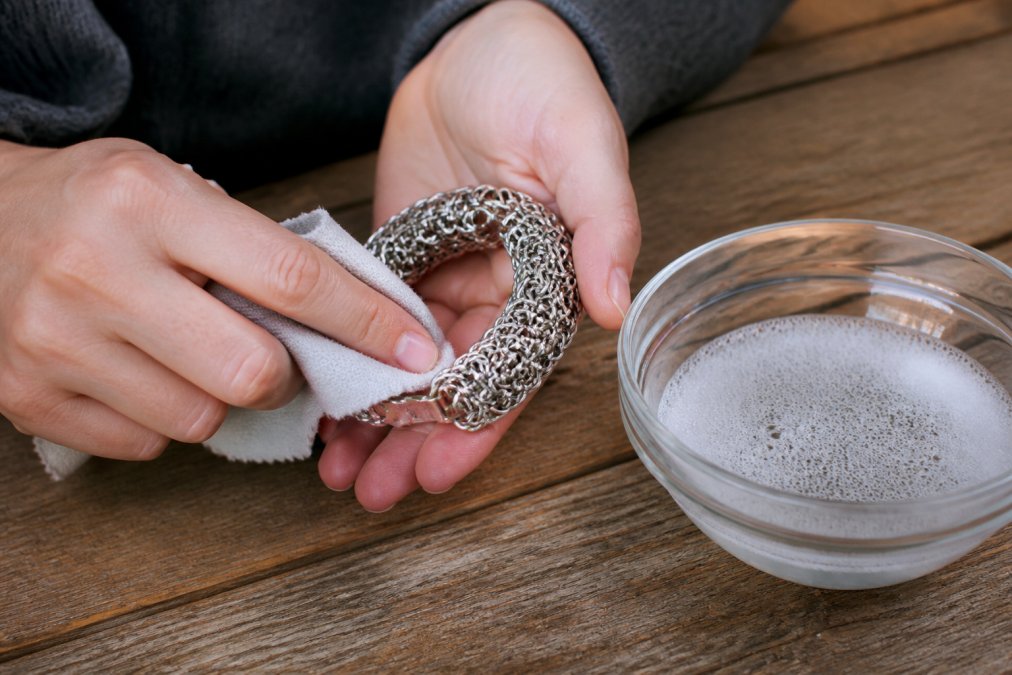
The routine takes two minutes:
- Fill a bowl with warm water and one drop of mild soap.
- Soak the piece for a few minutes to loosen residue.
- Work a soft-bristled toothbrush into the ring junctions.
- Rinse under running water and pat dry with a lint-free cloth.
- Leave it to air-dry completely before wearing or storing.
Handmade vs Mass-Produced: What You Are Actually Paying For
Handmade jewellery costs more because a person assembles it, inspects it and closes every connection by hand. Mass-produced pieces are stamped and assembled by machine at volume, which is why they cost less and why their findings are often the cheapest available component.
Frequently Asked Questions
What is the most durable metal for sensitive skin?
Stainless steel, titanium and niobium are the most durable options for sensitive skin. Stainless steel resists tarnishing, scratching and bending during daily wear, which makes it ideal for bracelets, necklaces and chainmaille pieces. Titanium is lighter and equally strong, while niobium offers similar skin-friendly properties in a wider range of colours. All three avoid nickel, the metal most likely to trigger reactions in people with metal sensitivities.
Does stainless steel jewellery cause skin reactions?
Quality stainless steel rarely causes reactions because it contains minimal nickel and forms a stable surface layer that stops metal ions transferring to your skin. Reactions usually happen with low-grade steel that has a high nickel content or worn plating that exposes the base metal underneath. If you have reacted to stainless steel before, check whether the piece was 316L grade or surgical steel, as these are the grades most suitable for sensitive skin.
How can I tell if jewellery is truly hypoallergenic?
Look beyond the label. Genuine hypoallergenic jewellery uses metals that resist corrosion and release few ions, such as 316L stainless steel, titanium or niobium. Check the findings, which are the clasps, ear wires and jump rings, because these are often made from cheaper metal than the main piece. Ask the maker which metals are used throughout, including the findings, and whether the piece is nickel-free.
Why does my skin turn green with some jewellery?
Green skin usually comes from copper in the metal reacting with acids in your sweat. It is not an allergic reaction and it is not harmful, but it signals that the metal is corroding. Durable jewellery made from stainless steel, titanium or niobium does not contain free copper, so it will not leave a green mark. If a piece turns your skin green, the plating or base metal is breaking down.
Is nickel-free jewellery the same as hypoallergenic?
No. Nickel-free means the piece contains no nickel, which removes the most common trigger, but other metals such as cobalt or chromium can still irritate sensitive skin. Hypoallergenic is a broader claim that the piece is unlikely to cause a reaction at all. For the safest choice, look for nickel-free jewellery made from stainless steel, titanium or niobium, and check that the findings match the main piece.
How do I clean stainless steel jewellery without damaging it?
Wash stainless steel jewellery with warm water and a drop of mild washing-up liquid, then rub gently with a soft cloth or soft-bristled brush. Rinse well and dry immediately with a lint-free cloth to prevent water spots. Avoid bleach, chlorine and abrasive cleaners, which can pit the surface. For chainmaille, work along the direction of the rings so you do not catch the links. Store pieces separately to stop scratching.
Will handmade chainmaille jewellery be too heavy for everyday wear?
Weight depends on the ring size and metal used. Stainless steel chainmaille is denser than aluminium, so a full collar piece will feel heavier than a bracelet. Many people wear stainless steel bracelets and necklaces daily without discomfort because the weight distributes across the surface rather than pulling on one point. If you are new to chainmaille, start with a bracelet or a shorter necklace before committing to a larger piece.
How long does handmade jewellery take to arrive?
Lead times vary by maker and piece complexity. Small-batch handmade jewellery is assembled to order, so it takes longer than picking an item off a high street shelf. Check the maker's stated processing time before you buy, and look for clear delivery estimates at checkout. If you need a piece for a specific date, contact the maker first to confirm whether they can meet it.
Sensitive skin and durable jewellery have always been a difficult pairing, mostly because the cheap options fail exactly where it matters: the findings and the finish. Sanctuary Studio builds for that gap, with handmade, small-batch stainless steel chainmaille that will not tarnish or fade, assembled entirely by hand, and safe for metal sensitivities. Shop the Collections and choose a piece you can wear every day without thinking about it.